“History is something that very few people have been doing while everyone else was ploughing fields and carrying water buckets.”
— Yuval Noah Harari
There are books that inform you. And then there are books that dismantle something you did not even know you were carrying.
Sapiens is the second kind.
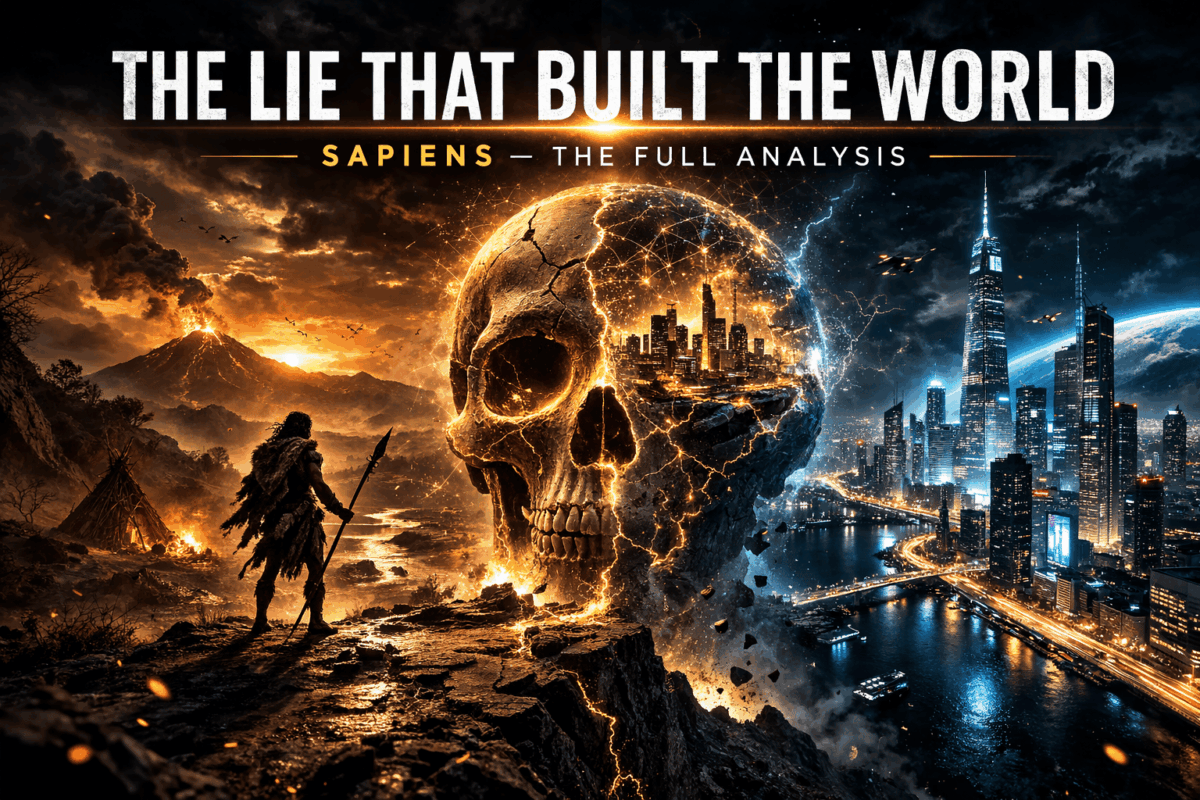
Published in 2011 by Israeli historian Yuval Noah Harari, it traces the full arc of human history — from a forgettable primate walking the African savanna to a species rewriting its own DNA and building artificial minds.
But this is not a history book in the traditional sense. Harari does not celebrate human progress. He interrogates it. He holds it up to a cold, biological light and asks: was any of this actually good? For whom? And at what cost?
What follows is the most complete extraction of the book’s ideas you will find without reading it yourself. Every major argument. Every unsettling insight. And at the end — exactly how to apply it to the decisions you make today.
Part One: The Cognitive Revolution — The Lie That Built the World
For most of human prehistory, Homo sapiens was unremarkable. We were not the strongest animal. Not the fastest. Not even the most numerous primate. Several other human species existed alongside us — Neanderthals, Homo erectus, Denisovans.
Then, roughly 70,000 years ago, something happened inside the human brain. Scientists call it the Cognitive Revolution. And it changed everything — not by making us smarter in the conventional sense, but by giving us one extraordinarily strange ability.
The ability to believe in things that do not exist.
Every other animal can communicate about objective reality. A chimpanzee can warn its group about a predator. A bee can signal the location of flowers. But no other animal can discuss things that are not physically present — gods, nations, corporations, human rights, money, justice.
Homo sapiens can. And this changes the mathematics of cooperation entirely.
Most social animals are limited in group size by the complexity of maintaining personal relationships. Research suggests humans can organically track and trust around 150 people — what scientists call the Dunbar number. Beyond that threshold, social cohesion breaks down without a new kind of glue.
That glue is shared fiction.
When millions of strangers believe in the same god, the same currency, the same legal system — they can cooperate at planetary scale without ever meeting. An Egyptian farmer and a Japanese banker who share no language, no culture, and no personal history can still exchange value through money. Because both believe in the fiction.
The Peugeot test: The car company Peugeot does not exist as a physical object. It is not its factories. Not its employees. Not its cars. If every factory burned and every worker quit, Peugeot could rebuild — because Peugeot is a legal fiction inscribed in collective imagination. The cars are real. The company is a story.
This is the structure of almost everything humans have built. Nations. Banks. Laws. Religions. Human rights. None of these exist in the physical universe. They exist because enough people agreed — and kept agreeing — that they do.
Harari calls this layer of existence inter-subjective reality: neither purely physical like a mountain, nor purely personal like a dream, but real in its consequences because it lives in the shared minds of millions.
The uncomfortable implication: Objective truth is less powerful in shaping human behavior than shared mythology. Whoever controls the dominant stories controls the world.
Part Two: The Agricultural Revolution — History’s Most Successful Trap
Ten thousand years ago, humans made what seemed like an obvious upgrade. Instead of wandering in search of food, they settled, planted crops, and built permanent structures. Civilization was born.
Except it was not an upgrade. It was a trap.
The Agricultural Revolution increased the total number of humans on Earth dramatically. More food meant more people. More people meant more soldiers, more workers, more genetic copies of Homo sapiens spreading across the planet.
By the only metric evolution cares about — the replication of DNA — it was a triumph.
But ask a different question. What happened to the individual human living through it?
Before farming, humans worked roughly four hours a day. They ate from dozens of different species — varied, nutritionally rich. They moved freely. Their bones were strong. Skeletal records show early farmers were shorter, more disease-ridden, and more malnourished than their forager ancestors.
The workload exploded. The diet collapsed. The freedom disappeared.
Wheat did not liberate humanity. Humanity became wheat’s labor force.
Harari introduces a concept here that echoes far beyond agriculture: the Luxury Trap.
An innovation is adopted because it makes life easier. The system adapts to the new efficiency by raising its expectations. The original convenience becomes a rigid necessity. And the user is now working harder than before to maintain a baseline that simply moved upward.
Email was supposed to save time. It shifted the baseline expectation of communication so dramatically that professionals now manage hundreds of messages a day — more correspondence in a week than a medieval merchant handled in a lifetime.
A salary raise was supposed to reduce financial stress. It recalibrated your consumption standard within months.
The ratchet only turns one direction.
The evolutionary vs. individual success divergence: This is one of Harari’s most disturbing arguments. The metric of evolutionary success — proliferation of genetic copies — is completely decoupled from the subjective experience of the organism. A species can be wildly successful while its individual members live in misery. The modern factory-farmed dairy cow is, by DNA count, one of the most evolutionarily successful large mammals on Earth. Its lived experience is something else entirely.
Progress for the system. Suffering for the individual. This pattern, established at the Agricultural Revolution, has not stopped.
Part Three: The Unification of Humankind — Three Myths That Merged the World
Despite wars, cultural differences, and geographic separation, the macro-trajectory of human history runs in one direction: toward integration. Toward a single, interconnected world.
Three forces drove this convergence. Not morality. Not shared values. Three inter-subjective myths powerful enough to pull strangers into a common system.
Money is the most elegant. It requires no shared god, no shared language, no shared history. Only shared trust in the token. A Roman merchant and a Persian trader who despised each other’s religions could still exchange gold. Money converts almost anything into anything else. It is the most universal and egalitarian system of mutual trust ever invented — and it works precisely because it asks nothing of you except belief.
Empires did the heavy lifting through force. They standardized languages, laws, road networks, measurement systems. They were brutal instruments. But they were also engines of homogenization that pulled disparate groups into shared administrative structures. Most modern cultures are the hybrid remnants of historical empires. There are no truly isolated, authentic cultures left. All of them were absorbed, blended, overwritten.
Universal religions provided the legitimacy that raw power could not. If a king declared a law, it could be challenged. If a priest declared the same law was God’s will, it became cosmological. Religions converted the arbitrary into the inevitable. They made the emperor’s decree feel like the order of the universe.
Together, these three systems did not unite humanity through high-minded idealism. They did it through cold, mathematical pragmatism. Trade is more profitable than war. A common currency is more efficient than barter. A shared legal code reduces transaction costs.
The engine of cognitive dissonance: Cultures are not logically consistent. They are collections of conflicting values held in uneasy tension. The friction between these values — Liberty versus Equality, Progress versus Tradition, Individual versus Collective — is not a flaw in the system. It is the engine that drives cultural change forward. When citizens attempt to resolve the contradiction, new political, social, and technological movements are born.
Part Four: The Scientific Revolution — The Power of Admitting You Don’t Know
In 1500, European cartographers began doing something no previous civilization had done. They started drawing maps with blank spaces at the edges. Regions marked simply: unknown.
Every previous culture had drawn its maps as complete. The Chinese, the Arabs, the Greeks — their maps were full. What was not known was either invented or omitted. The world was already explained.
European explorers drew the gaps. Then sailed into them.
This single psychological shift — the institutional willingness to admit ignorance and then fund the investigation — is the psychological core of the Scientific Revolution.
Not the telescope. Not the microscope. The word ignoramus. We do not know. Yet.
Previous knowledge systems — religious, philosophical, traditional — claimed completeness. They preserved and interpreted existing truth. Modern science claims incompleteness and funds the search for what is missing.
This admission of ignorance is not weakness. It is the most productive intellectual posture ever adopted.
But the Scientific Revolution did not happen in a vacuum. It required fuel. That fuel was capital — and the alliance between science, capitalism, and imperialism created a feedback loop that has not stopped accelerating.
The loop: Science demonstrates it can produce power — military, agricultural, medical. Power attracts investors and governments who want more of it. Those investors fund more science. More science produces more power.
The result is not neutral progress. Science is always steered by the ideological and economic agendas of whoever funds it. The atomic bomb was not an accident. It was a funded priority.
The Capitalist Creed is the ethical engine underneath all of this. Its central commandment: profits must be reinvested into production. A static economy is a dying economy. Growth is not optional — it is the baseline condition for the system’s survival.
This transforms how humanity relates to the future. Credit — borrowing against tomorrow — becomes the mechanism that finances today’s ambitions. Every startup funded on projected future revenue, every mortgage, every government bond is a financial bet that the future will be larger than the present.
The world runs on belief in growth. And that belief must be continuously maintained.
The Five Mental Models Worth Keeping
These are the frameworks from the book that have the widest practical application.
1. Inter-Subjective Reality
Separate what is physically real from what exists only in shared belief. Money, prestige, job titles, national identity — these are fictions with real consequences. When you understand which category something falls into, you can make clearer decisions about what you are actually willing to sacrifice for it.
2. The Luxury Trap
Every convenience eventually becomes a necessity that spawns new obligations. Identify new tools or lifestyle upgrades before you adopt them and decide in advance what your ceiling will be. If you do not set the limit, the system will set it for you — always higher.
3. The Dunbar Limit
Human neurobiology cannot organically track or maintain trust with more than approximately 150 people. Beyond that number, organizations require shared mythology — culture, mission, process — not personal relationships. Trying to run a 500-person company like a family will always fail.
4. The Evolutionary Success Divergence
Never confuse a system’s success with an individual’s well-being. A metric that looks good at the macro level — GDP, user growth, total output — may be built on individual misery. Ask both questions separately.
5. The Ignoramus Framework
Certainty breeds fragility. The most adaptive posture — personally and organizationally — is to systematically map what you do not know and fund the investigation. Build red teams. Tolerate exploration with no immediate return.
Three Uncomfortable Truths
Progress usually optimizes for the system, not the individual.
The Agricultural and Industrial Revolutions expanded collective human power enormously. The individuals living through them frequently had worse diets, longer working hours, and deeper psychological alienation. The system improved. People paid for it.
Your desires are not entirely your own.
What you experience as your most personal, authentic ambitions — the lifestyle you want, the person you want to become, the things you feel you need — were largely written for you by the imagined orders you were born inside. Romanticism, nationalism, and consumerism are software running on your hardware. Most people never inspect the code.
There is no inherent justice in biology or history.
Social hierarchies built on race, gender, and class are not rooted in biological reality. But they are self-reinforcing. Once established by historical accident, they create the conditions that appear to justify themselves. The universe does not care about fairness. Justice is a human project that requires active maintenance — not a natural equilibrium.
How to Apply This to Your Life — Right Now
Run a Fiction Audit.
Take a major source of stress in your life. Ask one question: is this a threat to my physical reality — my health, my time, my safety — or is it a threat to an inter-subjective fiction — my career trajectory, my status, my social image? Much suffering is the result of sacrificing objective well-being to protect a fictional identity. Name the fiction. Then decide if it is worth the cost.
Set artificial ceilings on new conveniences.
Before adopting any new tool, service, or lifestyle upgrade, define the maximum role it will play in your life. This is not Luddism. It is preventing your baseline from permanently shifting upward before you have consciously chosen the new level.
Stop solving external problems to fix internal states.
Human biochemistry regulates happiness to a biological baseline. After a major win — a promotion, a purchase, a milestone — the emotional return to baseline is faster than almost anyone expects. Chasing external achievements to produce internal peace is biologically inefficient. The intervention that actually moves the set-point is internal: perception, meaning, practice. Not acquisition.
Find the contradictions in your field.
Every industry, every organization runs on conflicting core values held in tension. These fault lines are not problems to eliminate. They are the exact locations where genuine innovation becomes possible. Identify the contradiction. Build the bridge.
Curate your comparison inputs ruthlessly.
Global media ensures you are always benchmarking yourself against the top fraction of one percent of human experience. Social platforms are architecturally designed to generate the gap between where you are and where their advertisers need you to want to be. A satisfied user does not click. Limiting exposure to relative-deprivation triggers is not avoidance. It is a rational response to a system designed to manufacture inadequacy.
Anchor your life to meaning, not pleasure.
Research consistently shows that happiness correlates more strongly with viewing life as meaningful than with accumulating pleasurable experiences. A life organized only around pleasure is fragile — any disruption dismantles it. A life organized around a larger narrative — a mission, a commitment, a contribution — absorbs friction without collapsing.
Build shared myths deliberately in your teams and communities.
Once a group exceeds 150 people, personal relationships are no longer sufficient to maintain cohesion. You must design the shared fiction: a clear mission, explicit values, rituals, and language that create a common identity. This is not manipulation. It is architecture. Every functional large-scale human organization — from ancient empires to modern companies — runs on it.
The Question the Book Leaves Open
Harari ends Sapiens not with an answer but with a question.
We are the first species in four billion years of life on Earth to be on the verge of redesigning ourselves. Genetic engineering, brain-computer interfaces, and artificial intelligence are not simply new tools. They are the beginning of a transition from natural selection to intelligent design.
Which means the question of what comes next is not a scientific question. It is a political one. A mythological one.
Whose values will be encoded in the next stage of life?
The species that conquered the world by writing shared fictions is now writing the most consequential fiction of all: the definition of what it means to be human.
That story is not finished. The map still has blank spaces.
The only question is whether you are reading the map — or helping draw it.
If this summary raised a question you cannot answer yet — leave it in the comments below. That is where the real conversation starts.